
At the beginning of Dandy’s journey, it was a company that strove to meet dentists where they were. In the clinic, doctors needed support in the tools they used, the digital workflows that were becoming more and more common in a largely analog field, and the dental products that manufacturers were sending to their patients. Be approachable. Be friendly. t
After several years of building a solid foundation of doctors of single-location clinics, Dandy began to shift it’s focus onto multi-location practices, and eventually to enterprises that oversaw dozens of clinics. The question became, could the existing brand guidelines flex enough to attract bigger fish?
When I was hired in 2024, I was put to the task of exploring this question. I began the process of getting to know the brand by auditing it’s preexisting creatives and learning how they performed.
Role
Designer, Manager
Team
Cristen Post
Lead Designer
Lauren King Thompson
Brand Marketing Senior Manager
Renee Haufmann
Copywriter
Shannon Greenbaum
Project Manager
Justin Gabbert
VP of Growth Marketing

The most radical shifts we did early on was the introduction of citron, and expanding the darker shades of teal. Citron spoke the most towards the speed of our scanning capabilities, the short delivery periods of product, and the fast digital dental workflows Dandy could offer.
It was especially pivotal in being the beacon for our 20x20’ trade show booth at some of the biggest dental conferences in the nation.
To see the 20x20’ trade show booth




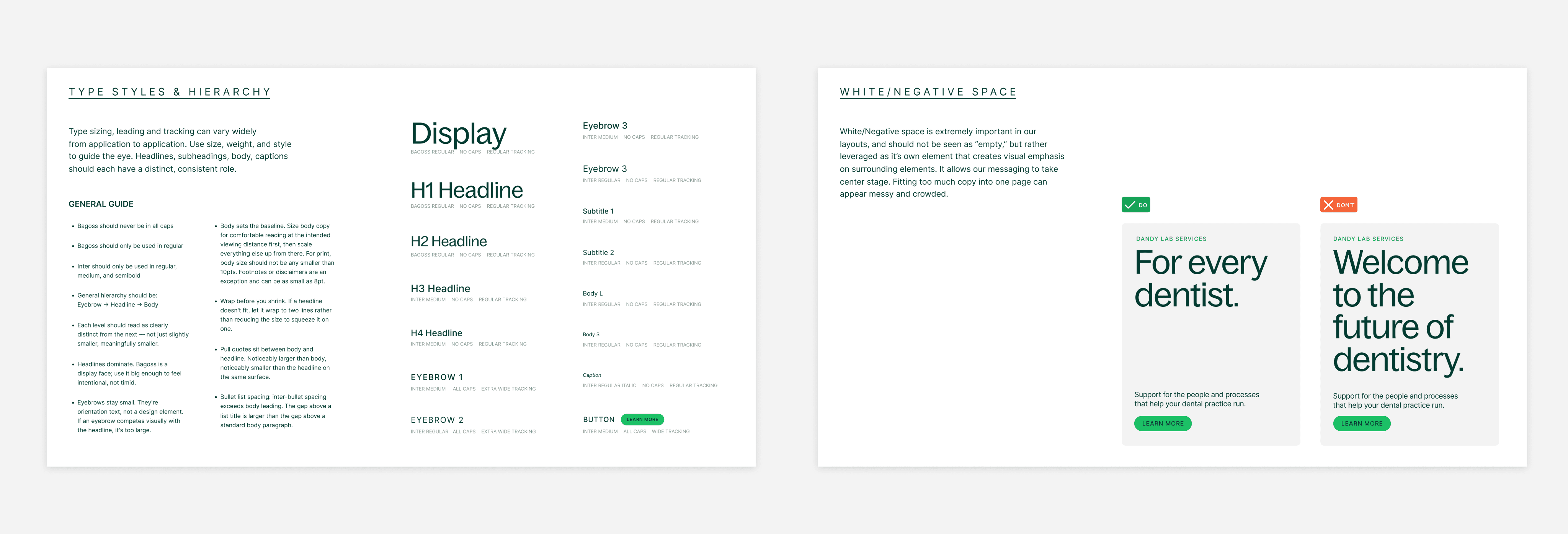
Defining how designers should approach type brought our print material into the most cohesion. Providing examples would give them an high-level shot of the guiding principles so that Dandy’s materials gelled together even if they were created at different times by different designers.


As most medical professionals, it is incredibly important that any imagery surrounding dentistry needed to be highly accurate. Dentures couldn’t appear too bright or unrealistically white. Crowns needed to be well fitted on the tooth prep and aligned to the gums. Case studies needed to have unaltered photographs of patient’s mouths in all their crude appearances. We could not serve doctors any creative asset that might suggest Dandy was unqualified to be in the medical profession. If there was a patient in the image, we made sure that the main focus was of the doctor included. It was best if the patient was turned away from the camera and not the center of the image.

While I experimented on how to combine dentistry and graphic treatment, there were several key words I wanted to keep in mind: “digital,” “scan,” “render,” and “design.” During that process, I looked at several pieces of reference from the scientific lens. Halftones felt like a way to connect dental from a micro level, and incorporate it into the larger brand in a way that feels digital and as a way to “scan.”
On a higher level, halftones served a solution to brand and unify any stock images we used. Dandy did not have a large internal photo archive, and the team had to heavily rely on stock imagery.

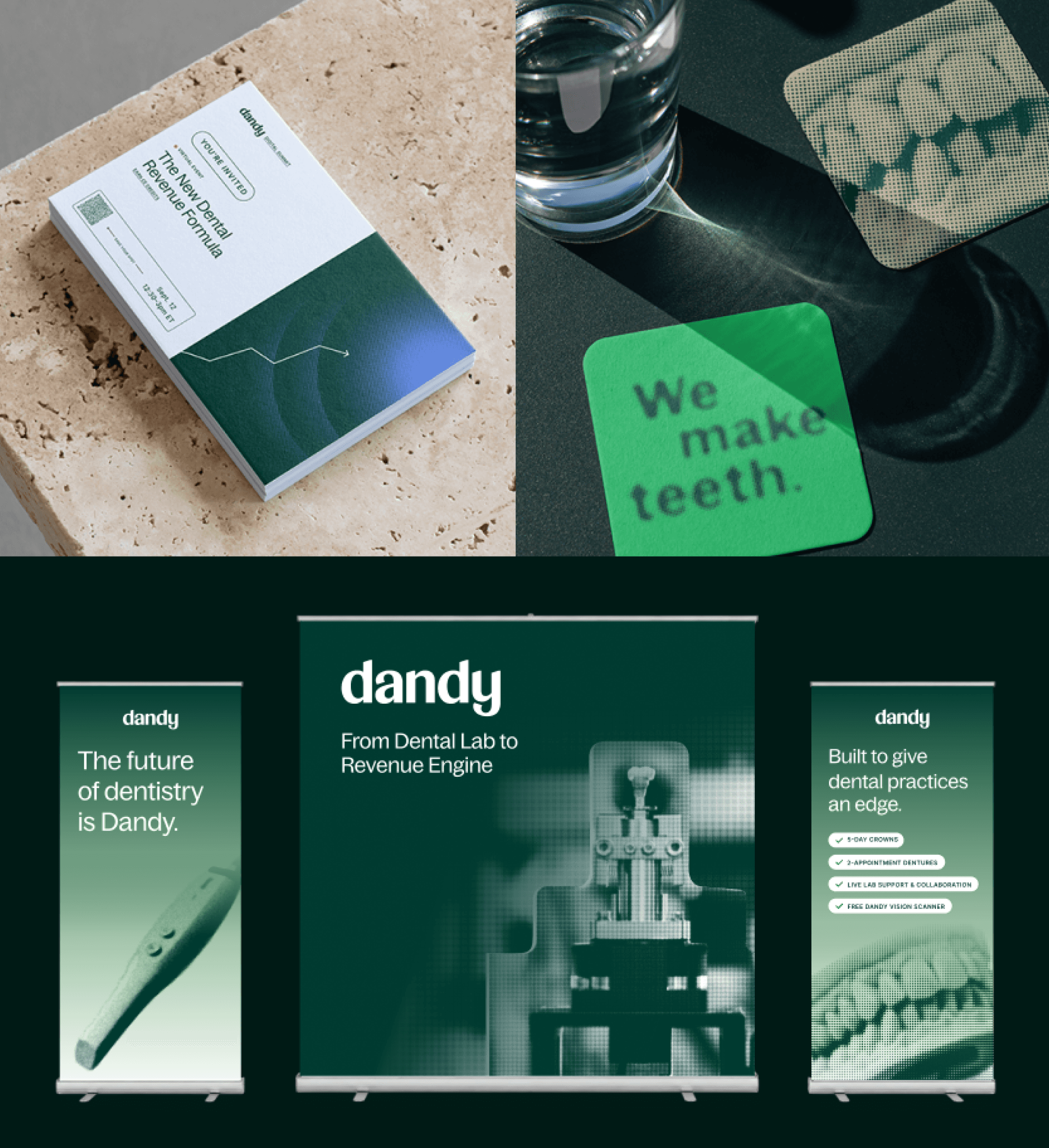
Halftones eventually because a headliner for our events. It added a graphic treatment solution to the larger challenge that Dandy did not have a large photography library. We were able to resolve this by treating photos with a style that would become recognizably Dandy. It created cohesion amongst the imagery.

During the entire development of these guidelines, the lead designer and I worked diligently to create documented processes and ways to standardize projects. As part of a two person internal team, I worked with our project manager to find the most efficient way to assign projects to freelancers and agencies. This required a complete overhaul of the company server folder org, creating workflows for file set ups, Figma artboard templates from various vendors, and file naming conventions. Really, anything that can be used as reference for external designers to make them self efficient. Having this inventory of resources allowed for the lead designer and I to review incoming work faster while also having maximum design time. The full development of the brand update only made us faster.

